Living in Arizona, you are probably familiar with Decomposed Granite. This form of rock is used in many of our local landscapes in place of turf and greenery. Decomposed granite is a byproduct of erosion of solid granite, coming in a variety of granulations. It is very similar to sand or gravel and comes in neutral colors that resemble it.
Decomposed granite is a great choice in a large community landscape such as that of a homeowners association. It is less costly than grass or artificial turf, requires less maintenance, and provides for an aesthetic backdrop for other plants and trees that are incorporated into the landscape.
As an HOA landscaping company, we have put together a simple and quick rule of thumb guide on the proper way to incorporate decomposed granite into a landscape.
Applying Granite
Installation of decomposed granite varies depending on the location that it is being applied. For installation in landscaped areas, it is expected to be applied at a 2 inch depth after compaction. For walkways or the like, that rises to a depth of 2-4 inches.
The finer the granulation of the granite, the easier it is to compact and less pervious the surface. This is important to note when choosing where to install certain types of granite. A rule of thumb that many HOA landscaping companies have is to use finer decomposed granite for walkways and a more sized material of granite near plants and trees.
HOA Landscaping and Granite Maintenance
Maintenance for decomposed granite includes applying pre-emergent for weed control, replacing decomposed granite where depth has been impacted by foot traffic and/or erosion, and the addition of stabilizers to provide strength (if necessary).
Need a Granite installation done for your community? Our enhancements division has got you covered!
We are fast approaching the beginning of fall where the leaves on our deciduous trees begin to change color and drop off as winter arrives. This presents the perfect opportunity for necessary pruning of the trees as they slide into dormancy during the winter months.
Deciduous trees such as Ash, Mulberry, and Elm (among others) are known for their ability to shed their leaves in the fall, providing beautiful multi colored leaves beforehand. The purpose of this is to help the tree survive through the winter months as the tree goes into dormancy. Once the tree has lost all of its leaves, this signals that it is the appropriate time to perform any necessary pruning as without the leaves on deciduous trees, it is much easier to see the branch structure and make informed cuts. Winter is a low stress time for these trees as they are known for being heat sensitive, giving another great reason for a winter pruning schedule.
It is important to get in and prune Deciduous trees during the cooler months as the branch patterns are more visible and the trees themselves develop healthier growth in the Spring when they put on new leaves. While it is recommended to prune any tree that seems to need it, it is important to be careful in your pruning choices and keep in mind that there are only a few valid reasons to prune; to prevent hazards, promote health of the tree, and increase or decrease the amount of leaves, flowers, and fruits.
Pruning should be done prior to the buds showing evidence of any swelling and should never exceed more than 25-30% of the canopy of the tree in any given year. When pruning, it is important to stay outside of the branch collar which will ensure that the wound from the cut heals naturally and correctly.
Finally, it is important to realize that pruning always results in wounds to the tree that can cause various responses such as increase in sprouting and susceptibility to disease and insect problems, so it is of the utmost importance that pruning is done professionally and appropriately.
ELS Maintenance has an entire division dedicated to Arbor care that specializes in keeping trees such as Deciduous trees maintained and healthy. Learn more about our Arbor Division and what they can do for your HOA community or commercial property here.
It’s officially time for OverSeeding here in Arizona! As temperatures begin to cool, we are looking to transition turf from Summer Bermuda to Winter Rye grass. Because OverSeeding is a process with multiple different stages and steps, many people are not sure where to start. Not to fear, we’ve got you covered by giving you all of the information you need to understand the first step in Overseeding this season; Scalping.
Download a Shareable Version of this article here.
What is Scalping?
Scalping, in its simplest terms, is a preparation technique that involves mowing turf lower so that the stems of the grass are exposed. This is done by lowering the mow height on the lawn mower while mowing, thus creating the brow-colored lawn that you see. This is specifically important in fall scalping as it allows the Bermuda to stay stronger while going dormant and allows the Rye seed to reach the ground.
How is Scalping done? In order to properly and effectively scalp, we start off by cutting the water a couple of days before scalp and then proceed to drop the mow height about 1-3 days prior to OverSeeding. After mowing, we collect and remove most of the clippings (leaving some as mulch for the OverSeeded seed). Once this is done, the turf should appear brown/tan as only the stems of the turf remain and a little bit of the soil is exposed. Light de-thatching, or the removal thatch accumulation, during this time ensures that the seed has appropriate contact with the soil.
After scalping, turf should be ready to move forward in the OverSeed process with the application of new seed. This new seed will require more frequent water times with shorter watering duration as we want to be sure to keep the seed moist without floating it.
Benefits of Scalping
Scalping, if done correctly, has a variety of benefits when it comes to a healthy transition for turf. Scalping works as a clearing process to ensure that the turf is free of debris, clippings, and thatch that could prevent the lawn from taking on new seed. This makes it easier for the seed to reach the soil while also working to prevent disease and turf health.
Another benefit of winter scalping is that the process exposes the soil to more sunlight, warming up the soil and promoting the growth of the seed.
Finally, scalping brings the entire lawn’s turf down to the stem, ensuring that all areas are the same height and receive the same amount of new seed. This promotes even growth throughout and leads to a better-looking lawn as the new seed grows in.
While it may not be appeasing to see the brown turf that appears following scalping, it is important to remember the benefits and reason behind performing this step when OverSeeding. The process takes anywhere from 4-6 weeks, but in time the brown turf that you are finding following the scalping process is replaced by healthy, strong winter grass that is appropriate for the season and promotes long term health.
Temperatures have been on the rise in recent weeks, hitting triple digit numbers here in the valley nearly every day. With this time of the year bringing in excessive heat and very little rain to cool our landscape down, certain plants are feeling the burn. One plant in particular that is suffering some consequences of these high temperatures, reflective heat, and little rain is the Lantana plant, commonly found here in the desert planted along sidewalks and roadways to beautify the area.
What Are Lantanas?
Lantanas are evergreen plants that are part of the broadleaf variety and are often classified as shrubs. These plants are a perennial and commonly found here in Arizona as they can survive on very little moisture and overly abundant sun. Lantanas should receive at least six hours of sun a day and most plants of the Lantana species thrive in hotter temperatures such as that of Arizona.
There are about 150 species of Lantana. Here in the desert, we most often find the following species:
L. Montevidensis: Also known as “Trailing Lantana” or “Weeping Lantana.” This plant is a low shrub that often takes the form of a vine offering flat groundcover. This species of lantana is strongly scented and can be differentiated from other lantana plants by its oval shaped leaves.
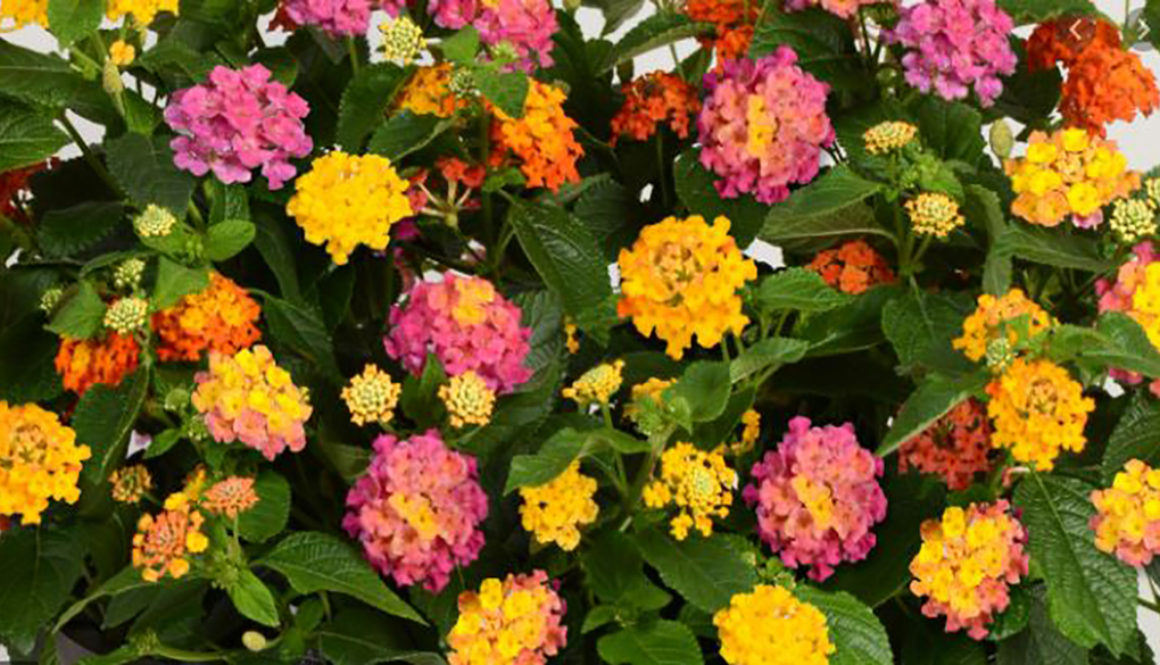
Lantana Camara: Also known as “Big Sage” or “Wild Sage,” this species is quite small and contains clusters of tubular shaped flowers that come in a variety of colors. The colors of flowers typically change after pollination and range from red, yellow, and orange, to white and pink.
Why Are Lantanas Burning?
Lantanas are often planted near sidewalks, granite, and roadways as a means of beautifying an area. Due to their location many of these plants are seeing significant sunburn from their surroundings as they experience the effects of heat reflection, especially when plants are seperated rather than planted in large groups. As temperatures rise to the triple digits and stay, the heat that hits the reflective surfaces of pavement, granite walls, and roadway is being directly reflected back on to the Lantanas planted near it. This causes the plant to overheat and suffocate as the plant burns due to the direct heat. Sunburn and lack of water effects typically look similar on the Lantana plant, however a quick probe into the soil can verify whether there is enough water or if the plant is burnt.
Healthy Lantana vs Sunburnt Lantana
What Can we do to Keep Our Lantanas Healthy?
Many people believe that the key to preventing burn on Lantanas is to increase the amount of water it’s given. While consistent watering is important to support your lantana plant through the summer, excess water left on the plants can enhance the effects of heat reflection and make your lantanas more susceptible to burn. It is important to be sure not to overcompensate with too much water to ensure that the plant survives. Watering on a normal schedule will ensure that the plants do not become too wet and attract the reflective sunlight.
Another popular myth to be debunked is that cutting down the plants will help lantanas survive the burn of the Summer heat. This theory is another misunderstanding as cutting the already burnt parts of the plant down exposes more of the plant and causes deeper burn. Instead of chopping lantanas, we should prioritize giving them proper water and letting the burnt parts of the plant grow out, saving the base of the plant in the process.
Lantana plants suffering burns in the Arizona desert will be able to fully recoup and survive the heat so long as they are not interfered with. As the heat reduces in the coming weeks, we will see Lantanas return to their thriving state and continue to beautify our desert home. This is when plant health can be assessed as to whether or not the plant should be removed (if it’s not growing back properly) or if a proper prune will suffice.
Let’s talk more about how you can maintain the investment in your landscape and improve its value. Call your business development team at any time or click here to fill out an inquiry form and we will get in touch with you.
Download a Shareable Version of This Document for Your Community Below!