Don’t Hose Down Trees in the Summer!
It’s very tempting during the summer to give the trees and shrubs in your yard a little “shower” with your hose while watering them. Surely, since we humans enjoy the temperature relief of cool water on our skin on a hot day, our plants will feel the same, right? Unfortunately for plants in Arizona yards, it’s not that simple. While all plants absolutely love the cleansing they get from natural rain, the water from our hoses does not provide the same benefits most of the time.
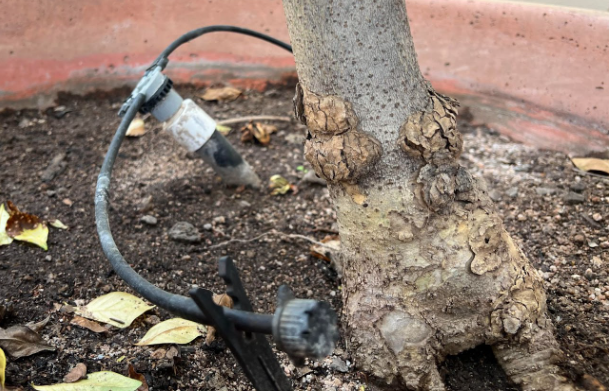
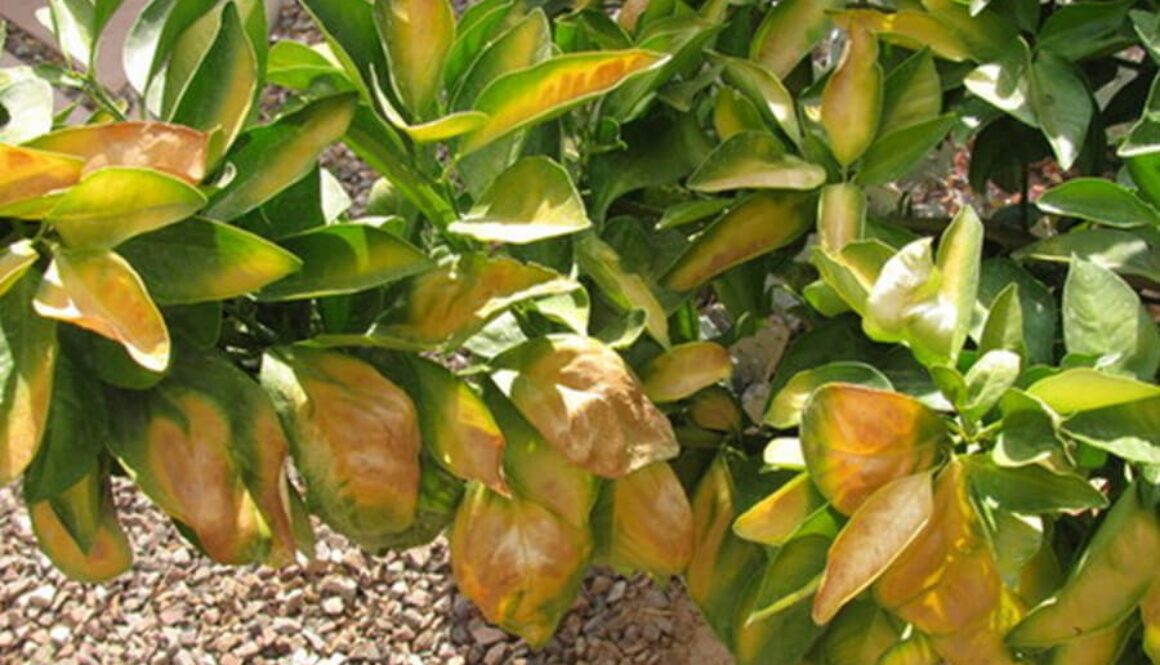
Our water supply, especially the non-potable, often reclaimed water that comes from our hoses and irrigation, contains salts and other mineral compounds that rain does not. When this saltier water evaporates, it leaves behind crystalline residues of these salts and minerals. You can see it in your irrigation as a crusty scale on your drip emitters, as whitened rings on the topsoil where water sits, and, if you spray your plants with a hose, as a white crust on the surface of leaves. This crust can have some deleterious effects on leaves, stems, and bark. The most significant issue is that it adds heat to leaves during the hottest part of the day. The salt absorbs heat and it gets concentrated directly on the photosynthesizing surface of leaves. If the salt crust hits the bottom of leaves, it can clog the pores through which plants take in Carbon Dioxide and release Oxygen, which suffocates them. Additionally, many tree species, such as all Citrus trees, have important oils on the surfaces of their leaves that get removed when sprayed. On bark and stems, salt buildup can also clog pores that allow airflow into the vascular structure of the tree, shrub, or cactus. This too partially suffocates them, and can increase the likelihood of rot forming. Overall, hose spraying does much more harm than good.
An exception to this is if you have rainwater collection tanks at your home. In this case, rainwater has sufficiently lower mineral content than non-potable infrastructure water that you could get away with wetting leaves with it. Even then, it’s still not recommended to spray leaves and trunks if it can be avoided, for the sake of preserving those leaf oils. Another exception to the rule is if a large dust storm or haboob hits your area and isn’t immediately followed up with rain. This dust heats up and clogs the pores of leaves the same way salty water residue does. In this case, there is an argument for spraying your plants, but ONLY at night or in the early morning! Do NOT, under any circumstances, spray trees in the middle of the day. Hopefully, the next monsoon season rain storm should arrive quickly enough that the dust doesn’t become a health problem for the trees.
At ELS Maintenance & Construction, we have an entire dedicated Arbor Division that can prevent, identify, and treat health issues in landscape trees using the latest best practices and science. If you know of a community or commercial center that needs new landscapers, email robbie@evergreenaz.com and we can get started!