
Why Do Arizona Turfs Need Gypsum and Sulfur?
If you’ve lived in the Phoenix area for a while you know that it can be difficult to keep plants happy. The summers are hot, sure, but the big problem can be found in the soil itself. The soil in the Sonoran Desert is very alkaline. Essentially, that means it’s salty. As salt builds up in our clay-rich soil, it can become impermeable, hardening and preventing air and water from easily soaking in. This is bad for the roots of plants, especially if they are not native to the desert or otherwise accustomed to salty soils. There’s probably no plant where this challenge is more obvious than grass.
Turf in Arizona faces several challenges, but one of the worst is the alkaline buildup in the soil, or more specifically, the consequences of this buildup. Plants have difficulty absorbing important nutrients when the soil gets too salty. Nitrogen and Iron are especially likely to be chemically trapped in salty clay buildup. Both of these nutrients are vital to a plant that gets regularly cut down like grass, and there is very little Nitrogen found naturally in desert soil. The lack of available Nitrogen, Iron, and most other nutrients, makes grass turn pale or yellow. It can also slow its growth, change its shape, or kill the grass altogether in especially impermeable spots. How do you solve this problem?
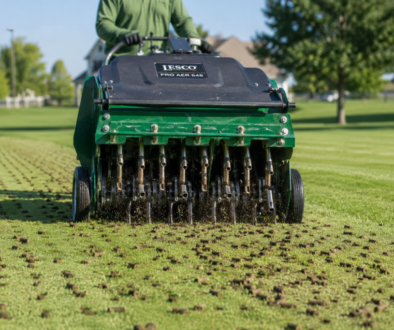
In addition to proper turf care like aeration and dethatching, substances can be added to turf spaces to break up built-up clay and drastically improve the health of grass. Soil Sulfur is a powder or granular supplement that does wonders on this front. Sulfur is acidic, and when allowed to dissolve with water, it chemically reacts with the salts in the ground and breaks them up. This opens up the previously impermeable soil, lowers the pH level around the roots of grass, and makes Nitrogen, Iron, and the other important nutrients available to be consumed by the roots. Gypsum is also a great option. It acts in a similar manner, reacting with salts and breaking them apart, allowing water, air, and nutrients to reach the roots of turf grass. The only difference is that it is chemically much tamer and has minimal impact on the pH level of the soil as a whole. There are many other products that can be used for similar purposes, called Soil Acidifiers. These are usually liquids that can either be sprayed on turf or injected directly into built-up soil to make it healthier for growth.
While these practices are relatively well-known for keeping grass happy, many do not know that the vast majority of landscaping plants in the desert can benefit from practices like this as well. While native plants like mesquites and cacti are accustomed to our soil type, non-native species of all sizes will likely perform better if the soil around them is amended with Gypsum, Sulfur, or other Soil Acidifiers at regular intervals. Try it on trees and shrubs that are underperforming! Consult a Certified Arborist if you are unsure whether your plants will benefit from these practices.
At ELS Maintenance & Construction, we always recommend soil amendments to turf areas at regular intervals that are best for keeping healthy grass. If you know of a community or commercial center that needs new landscapers, email contactus@evergreenaz.com and we can get started!